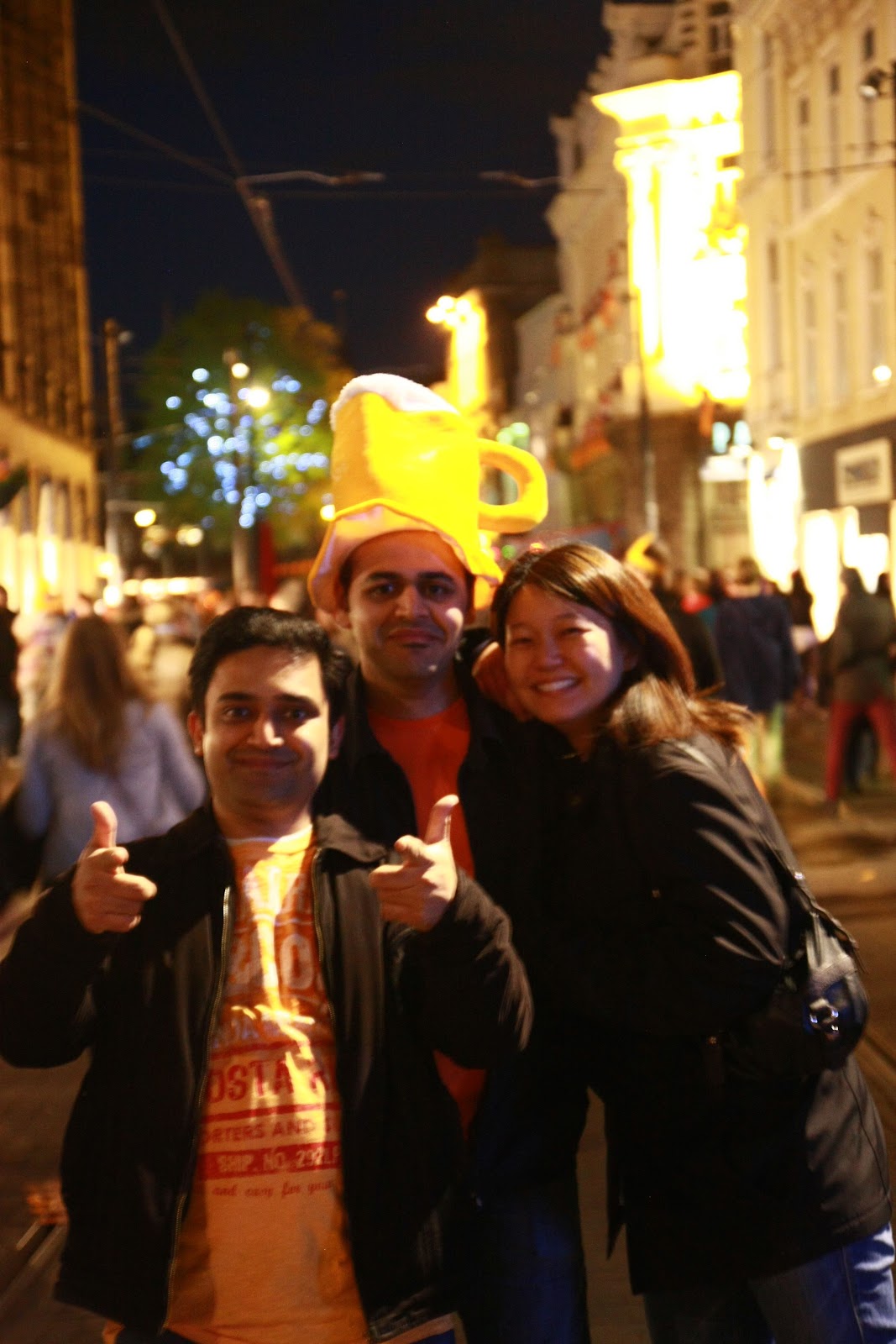
Wow, it's been so busy here, I can't believe i haven't posted since February. It's finally summer, and it all started with Queen's Day, on April 30th. We were incredibly lucky for the weather - it was clear and warm! (and strangely, the Sunday before, and the Tuesday after worth both miserable days...)
A little history about Queen's Day: it's probably the biggest public holiday in the Netherlands, celebrating the birthday of the last Queen (since the current's Queen's birthday is sometime in winter!). Everybody wears orange clothes (the official name of the Dutch royalty is the House of Oranje (orange), which is related to William of Orange in the UK, for those who remember their European history, who became King William (with Queen Mary) in England)
First, celebrations start with Queen's night, where lots of bands are playing, and people are already out partying, having fun, dressed in funny hats and anything orange, and buildings are decorated with Dutch flags and red/white/blue stripes.
Queen's day is a huge celebration, especially in Amsterdam. Everybody is outside wearing orange! Who knew that clothing companies would even make that many clothes in that color! (maybe only for people in NL?)
Also, one of the unique things about Queen's Day: is that she grants free permission for anyone to sell things openly. It's like a fun garage sale, people are selling their old clothes, records, home-cooked food, etc. People will even mark/reserve their spots on the pavements even days before Queen's Day
And, although this year the bands were mainly moved outside of the city center, there's still lots of music, especially in the floating barges/boats that are travelling around the canals, with their own DJ's, and pumping out loud dance music...(check out the YouTube video...)
Luckily, I came equipped with my Dutch/German week orange INSEAD polo-shirt, and Douwe-Egberts (local Dutch coffee company) was giving out these fantastic orange fedoras to complete my Queen's Day outfit.
The Dutch were really festive, and it was something comparable to Carnival in Den Bosch. It's an interesting comparison, because I think people in North Holland particularly like their regels (rules), and it's funny to see for 1 day, all the regels are disregarded... and very quickly, by the end of Queen's Day, the streets are being cleaned, and everything is back in order by the following day! So rRemarkably efficient, as if the rules can only be "broken" for only one day, but then everything needs to be back in order!
It was a great and hilarious experience, thanks to my INSEAD and hospital friends for making the day special! Definitely worth coming back to NL just for the experience...
During my SE Asian grand tour a few weeks ago, I took advantage of a long layover in HK (~12hours) to make a quick side-trip to Macau. Macau was previously a Portugese colony, and even back in the colonial days, it was famous for casinos, but they were small places, and I remember seeing one when we visited as a family in the early 2000's
The main (and biggest at the time) Macau casino in 2003, Casino Lisboa
But now.. wow. A few years ago, a number of Las Vegas resorts started building huge resorts - the Venetian, the Wynn... from the outside, it even looks like Vegas, except when you go inside and don't find any slots, or rarely blackjack, but tons of tables playing baccarat, and finding not burgers/pizza in the food court, but fried rice, Chinese bbq, etc. What a strange experience. Apparently, gambling revenues (and profitability) in Macau a few years ago have exceeded Las Vegas. Unbelievable. Sometimes I find it ironic that Asians are "well-known" for good math skills, but somehow, there's a "co-morbidity" towards gambling.
Despite what you might think, this is NOT Las Vegas
It's called the "Cotai Strip", with the Wynn, MGM, etc....
The interiors of some of these casino hotels are amazing, huge chandeliers, aquariums, everything you'd expect from Las Vegas like excess. What's also interesting is the staff you find in the hotels... they must be hiring models for eye-candy. (and holy cow, they were all really tall) Similarly, there were Indian security staff, Filipino dealers and casino attendants, etc.
Overall, an interesting day trip from Hong Kong airport. It's really interesting to see how the casinos have changed Macau. There is still a bit of the shady feeling from the old casino days, but with the large resorts, it seems more "legit", although I'm sure there's still some shadiness that's always lurking around the corner. Singapore has recently allowed 2 casinos, I wonder how much if it will change in the next few years if they allow more.
If you have a long layover in Hong Kong, it's worth the trip. Costs about $30-40 RT to Macau from HK Airport via high-speed ferry. Make sure when you arrive that you don't go to your transfer gate, or don't go through HK immigration. There's a special area that allows you to go directly to Macau without passing thru HK immigration. The boats leave directly from HK airport to Macau Taipa ferry terminal.
One might ask - anything special to eat in Macau? My answer: Macau-style egg tarts! So delicious, and you can even find them in the Venetian! And cheap too, HKD$8, or about US$1.25 or so per piece.
It's interesting to see how different languages deal with numbers.
I was at the immigration department on Friday, sitting and waiting for my number, #49, and in Dutch, it's said "negenenviertig ", or nine and forty, and this system is used for numbers greater than 20, but numbers less than 20 are similar in English (zestien = 16).
I find it strange how these two systems developed.. it reminds me of "big-endian" or "little-endian" systems from engineering. Do you put the larger number on the left side (as it is in English: twenty-one = 2 tens and then 1), or do you put the smaller numbers on the left (as it is in Dutch/German: negenentwentig, nine and then 20)
I once asked a Dutch colleague, when they writing down numbers that they hear on the phone, like negenentwentig, do they write it like it sounds (writing backwards, first then 9, then putting a 2 in front of it), because that's what I end up doing when I hear numbers and have to write them down.
Her answer: no, we just hear the whole number, and then write it.
Our brains must be so flexible to store numbers in different ways, it makes for funny mistakes when have to write a number I hear in Dutch from right-to-left, or when my Dutch colleagues tell me numbers in English but sometimes forget to switch the order.
I wonder why the system in English switches at 20? In English, numbers between 10-20, we say the 1 digit first, then "teen", but greater than 20, we say the 10's digit first, then the 1'st digit?
But in Germanic languages, it's always the one's digit first, then the 10's digit later, until you get to 100, then it's the 100 digit first, then the one's digit, followed by the 10's digit!!!
As you may have read, most of Europe, including Amsterdam, has been under an unusual winter freeze. It's been below freezing for over a week, and the canals have now frozen over.
In fact, the canal outside of my apartment has gone from a boat dock to frozen solid, and some people have made a makeshift ice skating rink!
Interestingly, these frozen canals are something very special for Amsterdammers, because now you see people skating on the canals! Apparently, this hasn't happened for over 10 years, and there's a huge discussion on whether a special race, the Eleven City Tour or "Elfstedentocht" will be held, something that only happens when the canals freeze. Apparently, it's over a 250km ice skating race, and officials are concerned whether the ice will support 16,000 people skating on the ice. I wonder if this is all overblown, especially when Minnesotans drive their car on the ice!
Pretty cool that when the canals freeze, you have a "skating highway" throughout all the various Dutch cities!
Update: HUGE snowstorm in NL today... probably 3-4 inches of snow. 850km of hughways throughout the are jammed due to snow. Despite this, people are STILL BIKING!
Just came back to NL after a vacation in SE Asia, and whew, it's cold here! It's like Minnesota weather... 20F (-10C), meanwhile, I hear that it's fairly warm back home in MN
I remember once telling Sen that walking in the cold (ie, below freezing) is no problem. BUt after biking a few blocks yesterday in that weather.. whew, it's COLD!
Who knows, either SE ASia reset my temperature expectations, or there's a big difference between the short walk from your car to the office vs. biking outside in below freezing weather.
btw - I arrived in NL from SE Asia with only a fleece... good thing I packed a jacket in my luggage which was completely useless while in SE Asia...
Happy New Years - I'm back to NL after a too-short visit back to the US. Strangely, seems like forever that I was back in the US, but also seems too short. It's a very strange feeling to have multiple homes.
I had this realization today after arriving at the airport that Amsterdam is feeling very familiar. It's so strange to go on a long flight, wake up in a new place, which seems strange and familiar at the same time. Especially when 3 places seem "home" to me - whether it's in Ohio where I grew up, in MN where I've been living, or NL where I've been working.
This particularly makes things complicated when people ask me now, "Where do you live?" or "Where are you from?". It usually goes something like "Well, I'm living in the NL now, but my actual home is in Minnesota, where I work, but I'm from Ohio". By then, most people have a really confused look on their face. Guess there's no simple answer for that question. I'm sure lots of international students in the US or even college students who study in a different state probably have similar identity crises, or even Americans posted overseas too. I wonder how long does it take for somebody to change their answer from where they grew up as a child as "Home" to where they're living as "home. Maybe it takes life-events like the birth of a child, or marriage, or just many years before people identify a new place as "home".
And in a random comment - I was thinking how some things I do in my house are still very "American". For example, bath soap. It's much more common in Europe to use bath gel instead of soap bars. However, I still prefer the soap bar. But - since soap bars aren't common here, it's difficult to find things like soap dishes! I had to import that one from the US.
Then - I was thinking - with the water being quite hard here (lots of calcium), soap bars don't lather up very well. Maybe that's why bath gel is more common? Would be interesting if that was a local adaptation to the water conditions here.
Any thoughts on soap from my readers? And welcome any comments on the thoughts about what defines "home"?
All the Christmas decorations are coming out in Amsterdam, it really feels like a special time, with special foods and drinks. They've really borrowed a lot from the German Christmas markets, but with a Dutch twist.
First - you start seeing these food trucks "Oliebollen krammen" showing up in various plazas, including Schipol Plaza!!
I loved the photo above because it was such a gray/cloudy day, I was in Schipol grabbing lunch before a train, and outside, in the corner of Schipol plaza, right outside the exit to get to the taxis, there's this bright little food truck sitting there..
Inside these foodtrucks, they're essentially mobile donut makers, frying up oliebollen (oil balls, there's got to be a better English translation!), and other variations, include apple-filled oliebollen, and of course, wafels.
Then, inside the city, they've converted many public areas, like the Leidseplein from an area with seats for the bars nearby and vendors into an super small ice-skating rink, and huts selling all sorts of great hot snacks for the cold, including bratwurst, churros (spanish donuts?), poffertjes (incredibly yummy mini-pancakes with butter and powdered sugar), wafels, pannekoeken (Dutch pancakes, a cross with a crepe and American pancake), chocomel (warm hot chocolate) and gluhwein (sweet warm red wine)Other plazas, like the Rembrandtplein are also converted into festive little areas.
It's so nice to see these little huts, it really feels festive! And, there's nothing like being in the cold weather and enjoying hot freshly-made poffertjes with a cup of warm hot chocolate! You've got all the essential food groups - pancakes, butter, sugar, and chocolate milk!
But - five Euros for the poffertjes/mini-pancakes! Totally worth it!
There's a probably one word that is quickly learned in NL, it's fiets, Dutch for bike. You learn this word quite quickly, because of all the signs: geen fiets (no bikes) fietsen worden verwijderen (bikes will be removed) fietspad (bike path) Het Zwarte Fietsplan (name of a bike shop that includes a large basket in the front) Bakfiets.nl (a bike for families, with a huge scoop/bucket in the front for little kids to sit in)
One of these days, I'll post a collection of photos, a sort of "fiets anthropology" that shows all the different sorts of fietsen found around town...
I've also wondered why the Dutch word for bike is so different from all the neighboring languages (ENglish, French, German)... and found this great article on Radio Netherlands "Fun Fact Friday"... apparently, the word fiets is so important in Dutch, there's lots of sayings that have evolved around it! Here's the story from the Fun Fact FRiday..
Bicycle = fiets:
The Dutch word for bicycle is fiets (pronounced "feets")... and nobody really knows why. In most languages, the etymology is obvious - the English bicycle, meaning "two wheels", the French vélocipède, meaning "fast feet", the German fahrrad, meaning "ride wheel".
This was originally the case in Dutch as well - the bicycle was officialy known as a rijwiel or "ride wheel". This term can still be found in combination with other words such as rijwielhandelaar or "bicycle store"
Some people say the word fiets came from E. C. Viets, a bicycle-maker in the 1880s, but it appears that the term was in use ten years earlier. Others suggest it is a corruption of the French word for speed,vitesse or even the French word for bicyclevélocipède. Still others say that it's an onomatopoeic word that simply sounds like a fast-moving bicycle: ffts. It has also been suggested that the word fiets is derived from vietsen, meaning "to move quickly" in Dutch dialect.
In any case, bicycles are a part of Dutch daily life and the word fiets has made its way into many common expressions. Here are a few typical examples:
Op díe fiets. Literally: On that bicycle. Figuratively: Oh, that's what you mean! Wat heb ik nou aan mijn fiets hangen? Literally: What's hanging on my bike? Figuratively: What's going on? What's happening? (Said by someone who is *really* surprised.) Geef mijn fiets terug. Literally: Give me my bike back. Figuratively: It's a joke referring to WWII when the Germans confiscated many Dutch bicycles; it's used to make fun of Germans. Snel door heen fietsen. Literally: To cycle quickly on. Figuratively: To go through something quickly, as in an agenda item on a meeting. Op een oude fiets moet je het leren. Literally: You have to learn on an old bicycle. Figuratively: Young people should learn about sex with an older (trusted) lover.
I'm seriously behind on blog posts, but just had to post about an amusing topic... passport photo requirements in the Netherlands, which is related to my work permit here. Ever wonder why some people have these terrible passport photos, where it looks like jail mug shot? I know why now....
My work permit in NL was finally approved, and one of the requirements is a passport photo. The immigration agency clearly outlined that the passport photo is a highly important part of the process. There are strict guidelines on what the photo should contain, and I should have a professional, authorized photographer to take my photo. US passport photos are not acceptable. Photo booth photos are not acceptable.
What?? Professional authorized photographer? Seriously? I've done my own passport photos before with a SLR and Photoshop, why would i ever use a professional photographer? And authorized photographers? How hard could this be? Sounds crazy.... until I read the Dutch regulations for passport photos. (and are sometimes completely comical)
1. Length from ear to ear must be 16-20 mm, and from chin to tip of head must be 26-30 mm (really? is the inspector going to measure my photo? and what if you're Vincent van Gogh, missing an ear?)
2. Dark eyeglasses are not permitted unless you have a medical exception and a doctor's signature (hm.. I guess the Unabomber's photo is OK if he was legally blind?!! And, I guess I'm in Amsterdam, there's probably a doctor's certificate for almost anything) 3. Headbe fully visible, except for those with high hairstyles, who are allowed to have their hair outside the photo frame.
4. My personal favorite and exact quote: "Broad smile and an open mouth is not allowed. That does not mean that there needs to be a surly or sullen look."
HILARIOUS! The IND says I need to have a neutral expression, and even advises me that a neutral expression doesn't mean I shouldn't look sad or surly. Hah!
If you're curious, ask me to post my photo (which I did myself) - I don't think there's any neutral expression photo that doesn't look sad or surly..
I had dinner with a INSEAD friend's classmate yesterday, an Dutch native that's spent some time in the US, and he asked me an interesting question. "Is there anything that you miss?"
It's interesting to think about what things you really miss, even when in a very diverse/international city like Amsterdam. Of course, you'll always miss the company of people and friends that you have in your home town, but what "things" did I miss? Thinking of this gives one an interesting perspective on what is your core identity.
In no particular order, here are some of the things I missed:
Mexican food: this one is probably top of mind because I tried to find a recommended Mexican place this weekend (via dutchgrub.com food blog), but they were closed for vacation! I need to find my Casa Lupita!
NPR: this one surprised me, but on my weekends here, I really miss the voices, stories, and laughter from listening to weekend NPR programs like Car Talk or "Wait Wait, don't tell me". Luckily, there's podcasts or NPR streaming, and I'm actually listening to Weekend Edition Sunday right now, covering the 9/11 memorial service in NYC.
Long Drives in my car: this one is usually associated with NPR, since I'm often driving around on weekend errands, listening to NPR. I know this one doesn't seem very environmentally friendly, but sometimes it's really handy to have a car. I've done a lot on my bike over the past weeks (strapping groceries, pizza boxes, takeout onto to the back of my fiets), but sometimes you're just limited to how much (and how big) of things you can carry on the bike
Minnesota summers / State Fair: Those last days of summer in MN are really special, the last few long nights and warm evening weather, and the the fun/people watching associated with the state fair. Something to really savor before the weather turns to fall and winter.
On a more serious note, Sept 10, 2011 marks ten years of starting work after graduation, and Sept 11th, 2001 was my first true "working" day at Guidant. Spend some time today to honor those affected by that tragic day.
About 2 weeks ago, I moved into my new place in Amsterdam... it was hard trying to decide where to live. Living in the center meant that I could feel like I was in a city (since I've always lived in the suburbs), and live in one of these traditional Dutch apartments, but it also meant I had less space, and ladder-like steps if I chose an apartment above the ground floor. Since the Dutch buildings are so tall (and they're not very deep), you need some serious steepness to go up the stairs. Although you'd think that the traditional Dutch buildings are deep, there's typically a garden (or mini-park) behind the buildings, and you'd never realize this while looking at these tall buildings from the street level.
Or, I could live slightly at the edge of the center (still in Amsterdam), closer to the hospital, and a bit more space.
In the end, I chose edge of center, which has been completely amazing. I have a tram stop in front of my apartment, it's 20 minutes by tram/metro to the hospital, or I can ride my bike, straight-shot, to the hospital, in... 20 minutes! And I'm really not that far from the center, I can reach the Leidseplein (main entertainment, restaurant area) in about 10 minutes by bike or tram. Plus it helped that this apartment already had a flatscreen TV, so I could hook-up my laptop to watch movies, etc.
And ironically, the owners of my apartment are actually living in the US now, in Georgia!
Opening a bank account was probably the biggest piece of culture shock for me here. First, as I've mentioned earlier, it's almost impossible to open a bank account in NL without a social security number (which I don't need for my short stay here). However, that makes it hard for me to pay my rent, since it's equally hard for me to setup foreign wires from the US while I'm here.
Luckily, the SSN only a Dutch bank regulation, and Belgium (only 1 hr by train, and one of my assigned sites), gladly welcomes your money if you're non-resident. And, Belgium cards work in the Netherlands! And everything can be done online. So much for laws... and ironically, my account is opened at the Belgian branch of a Dutch bank (ING).
Opening an account is a lot of work though. I started the process on Aug 5, and finally got my cards on the 26th.
1. You have to setup an appointment (!!) with the bank, can't just walk-in to open an account.
2. At my appointment, be prepared to bring a lot of paperwork: passport, employment contract (proving that you don't officially work in Belgium and not subject to Belgian tax), business cards (in case the employment contract wasn't enough), and proof that you are non-resident (ie, live outside of Belgium).
3. Even after all that, your account isn't immediately opened. Somebody has to REVIEW your paperwork, then they'll notify you that an account has been opened. (this took 1 week)
4. Your ATM card isn't issued immediately, it's shipped to the bank, and you need to go there to pick it up!
5. To use online banking, you need to get a special "card reader" (see photo), which supposedly makes your online banking more secure, but in reality, just makes it more troublesome to use. Whenever you login to online banking, you insert your card into the "card reader", it'll generate a one-time code, which you enter into the website. Similar authentication is used when you make online payments, you type a code from the website into the "reader", and it responds back with a number, which you re-type back into the website. Sounds like an RSA secureID, but more clunky. This "card reader" is also specially shipped to your bank, luckily, my branch already had one, so I didn't have to wait again for this.
Although it was painful, it's finally nice to have a local account, makes it easier, since some ticket machines here only take Euro Maestro (Mastercard affliate) cards, so none of my US cards work. That's really inconvenient, esp when you can't quickly get a ticket for a train departing in a few minutes from the machine, and there's a long line at the ticket counter...
There are some good parts though: I withdraw from ANY ATM in Europe (not just my bank's ATM) for no cost. (much better than the US system where I have to pay to withdraw my own money from other bank's ATMs.... these fees are a pure profit center for a bank). And most importantly, I can finally make my rent payments online instead of doing wires from the US!
One more interesting twist: when signing up for an account, you get your own bankier. Strangely, even if you have any questions or issues, you're supposed to only setup an appointment with your bankier. It seems so quaint, I've never had a single person to go to for US banks in the past, and especially now, when all my banking is online.
I'm sure many of you have had that experience of going into a new grocery store in a new city, not knowing where anything is, and spending lots of time in the store trying to find all your things.
Well - that's my experience every time I go shopping! First, I don't know where anything is, Second, everything is in Dutch, so it takes longer for me to figure out if I'm buying the right thing, especially for speciality items.
Like today - my goal was to buy shampoo (easy), and rubbing alcohol (hard). The rubbing alcohol was for my computer... I had spilled coffee all over my Thinkpad keyboard during a sleep study. Luckily, the Thinkpads are really tough - the coffee didn't damage the computer, but made the keys super sticky. Luckily, there are YouTube videos on how to clean the keys, using alcohol.
So I go to the drugstore, and start looking around. While I entered, I found 3 Chinese students who were also equally confused. Hilarious scene... 4 foreigners all really confused in the drugstore. I was trying to figure out if brandspiritus (95% ethanol) for EUR0.85 or alcohol ketonatus 96% (EUR2.50) was the same as isopropyl alcohol. Google translate on my phone didn't help either.. then I had an idea. Just smell it! brandspiritus definitely wasn't isopropyl alcohol... wish I had figured that out instead of trying to figure out the labels.
While I was searching, one of the Chinese guys came up to me, said hello in Chinese, and we started chatting a bit. It was s nice to find somebody else who is equally confused.. This guy was looking for face soap, and didn't know where to look. So, I tried to help, but it was really like 3 blind mice! must have been hilarious for the staff to watch. In the end, after a lot of searching, I found the soap... in two different places!
I think I lost over an hour in that shop trying to figure where things were at, and it wasn't a big shop!
Repeat that with the new grocery store I tried, and it made for a long (but entertaining) afternoon.
More great stories to come, including:
my new apartment
bike locks
toilets
how to buy beer if you want only 1 bottle...
Update: Now that I think more about it, brandspiritus is probably something for burning (wicker candles?), since brand = burning.... it would also explain why it was in a huge bottle vs. the smaller bottle for rubbing alcohol...
Just a quick funny post for today, seems like that I'm already well-known by my Dutch ENT colleagues. When I was first introduced to some of them, they they found a video dedicated to me on Youtube.... (for those of you who haven't heard about this yet...)
Seems like a bunch of you really enjoyed this last post. So - I decided to post a map to give you a sense of how it can be truly faster by bike than even tram.
From Sint Lucas Andreas hospital to Rembrandtplein is about 5km (~3 miles). Public transit time estimates 30 minutes for that ride!
And from the map, you can get a sense of how small Amsterdam truly is. The hospital is on the far eastern edge of the city, while the Rembrandtplein is just a bit east of the Center...
It's amazing, that even a bike could beat public transit!
As anyone that's visited Amterdam knows, bicycles are completely everywhere. Not until last week Friday did I totally understand how much you could do with a bicycle!
I decided to have dinner with one of our colleagues in the hospital, and the restaurant we were going to across the city. She had a bike, and I had arrived by tram. No problem, I thought, I'll just take the tram and meet at the restaurant.
Instead, I was offered a ride on the back of a bike, side-saddle style. You know, like what you see in the old 50's movies, or when travelling in Vietnam, one person pedalling, and the other riding off the back of the bike, with both legs on one side.
Really, I thought? Is it really possible? Our colleague, she said "yeah, it's the fastest way. People do it all the time". Here's when I realized I was up for a real cultural experience.
First - it's really tough to hop onto the back of a bike when both you and the bike need to be moving at some speed. That takes a bit of finesse. Not only that, there's not exactly a lot to hold onto on the back of the bike.
Second - it's kinda scary! like 3rd world scary! Dutch bikers are super aggressive, so I had cars passsing me on the side, the bike passing very closely to parked cars, other bikes overtaking us within what felt like inches! I would have been more afraid if I was actually facing towards the street instead of facing the sidewalk (ie, my legs were hanging off the right side of the bike, and bikes ride on the right side of the street)
In all though, it was a completely hilarious experience. After a couple of times, I mastered the technique of hopping onto the back of the bike quickly, and efficiently, and mastered hopping off when we came to a "red light" or street crossing. And, looking at the map, it's really amazing the progress that we made across the city. And as my friend pointed out, bikes are the most efficient way to cover the city!
She gave the following true example: a taxi from central station to home is about 20 mins and costs EUR25. A tram takes about 15 mins, and it's maybe EUR2-3, but a bike, takes 10 mins, and it's free!
Maybe I need to find a way to lease/rent a bike for my time here?
Past week has been super busy, and even though I don't have an apartment just yet, my co-worker based in Antwerp has just returned to the US, and luckily, I can stay in his place. It's so much better to be in a house than the tiny hotel room I've been using. Plus I don't have to pay EUR10 a day for wifi, and I get a kitchen where I can cook something. (not that Belgian/Dutch food is bad, but it's nice to have something simple)
Testing the use of my language skills can be hard, especially when you're understanding more written words, but understanding spoken words is hit/miss. I had a great experience today while getting lunch at the Panos Panini shop. Decided to try to speak "only Dutch", regardless if I get in trouble or not. Luckily it's a slow day this weekend in the shops..Here's the hilarious conversation (and for me to remember my new words from today):
Kent: Can I order a prosciutto panini? (Kan ik een prosciutto panini neemen?) Host: Is that for here or to go? Kent: For here, and also an ice tea (voor hier, en ook een ice tea) Host: You want the bottle or the can? (these were words I didn't know.. it was like you want the or the , where x and y are unknown) Kent: Uh, I want the carbonated one (met gaz) Host: (sooo graciously patient, and not switching to English, goes over to the fridge): We have a bottle (raising the bottle) or a can (raising the can) (een flas of een blikje?) Kent: Ooooh!! I'll take the smaller one (but not knowing the correct word for 'can') - (de klein..)
then.. after I finish my lunch, I asked:
Kent: How do you say "this" (raising my can) in Dutch? Host: Een blikje... (a can) Kent: "Blikje?" Host: Ja, blikje
Whoever you were, thanks for speaking slowly, being patient, not switching to English, and helping me learn! I'll never forget what is een blikje.
Past few days have been interesting, trying to arrange for housing and a bank account. I really have a better appreciation now for international students who arrive in the US who try to get all these things done.
Househunting was fairly straightforward, given the rental agency recommendation from a INSEAD colleague (that network is SO helpful), and I may have found a place. One amusing thing happened while apt hunting, where I stopped into a shop to buy a bottle of water. I went to the register, and the guy said in Dutch what I thought was "seven", and I was really confused, seven? seven Euros for a bottle of water? (mind you, I was jetlagged but awake).. and I thought, OK, I'll put out EUR7. I first started with the EUR2 coin, and was about to pull a EUR5 note, but then he just took it and gave me back EUR1.30. My rental agent laughed, and said to the shopkeeper: "nieuwkomers", which I was obviously one. Note: do people in NL say seven to mean seventy? How do you know when it's just seven or seventy? Just like how in Chinese you'd say 1 dollar, 4, meaning 1 dollar, 40 cents?
Anyhow, one task checked off the list.
However.. step 2, opening a bank account has proven to be more difficult. You'd think that a bank in NL would be more than happy to have your money, even the ones like Rabobank or ING, which were bailed out in the crisis. But no.. this turned into a really complicated case. First, every bank insisted that I needed a social security number to open, even though I had read accounts of people opening a non-resident account. I mean, I'm sure there are wealthy Russians, Indonesians, or other people coming into open accounts in the Netherlands with their overseas money. Even ABN-Amro advertises a non-resident account (but with a EUR20k minimum!) But getting a social security number is not easy - you have to prove that you have a work visa, a resident permit etc... but that not required for people who are here on short stays. Argh - seems like I just fell into a loophole in government policy. I'm sure that banks are checking social security numbers to avoid terrorist groups opening a bank account, etc, but I don't think I fit that profile. Please - take my money! You're a bank!
oh well - when frustrated, you just have to laugh. Just like a t-shirt I saw yesterday at a shop for baby clothes... the shirt said: "BABY GENIUS", and underneath it, was the text: "q t (pi)", as in the symbol for "pi". Hilarious!
Sunday, July 31, 2011
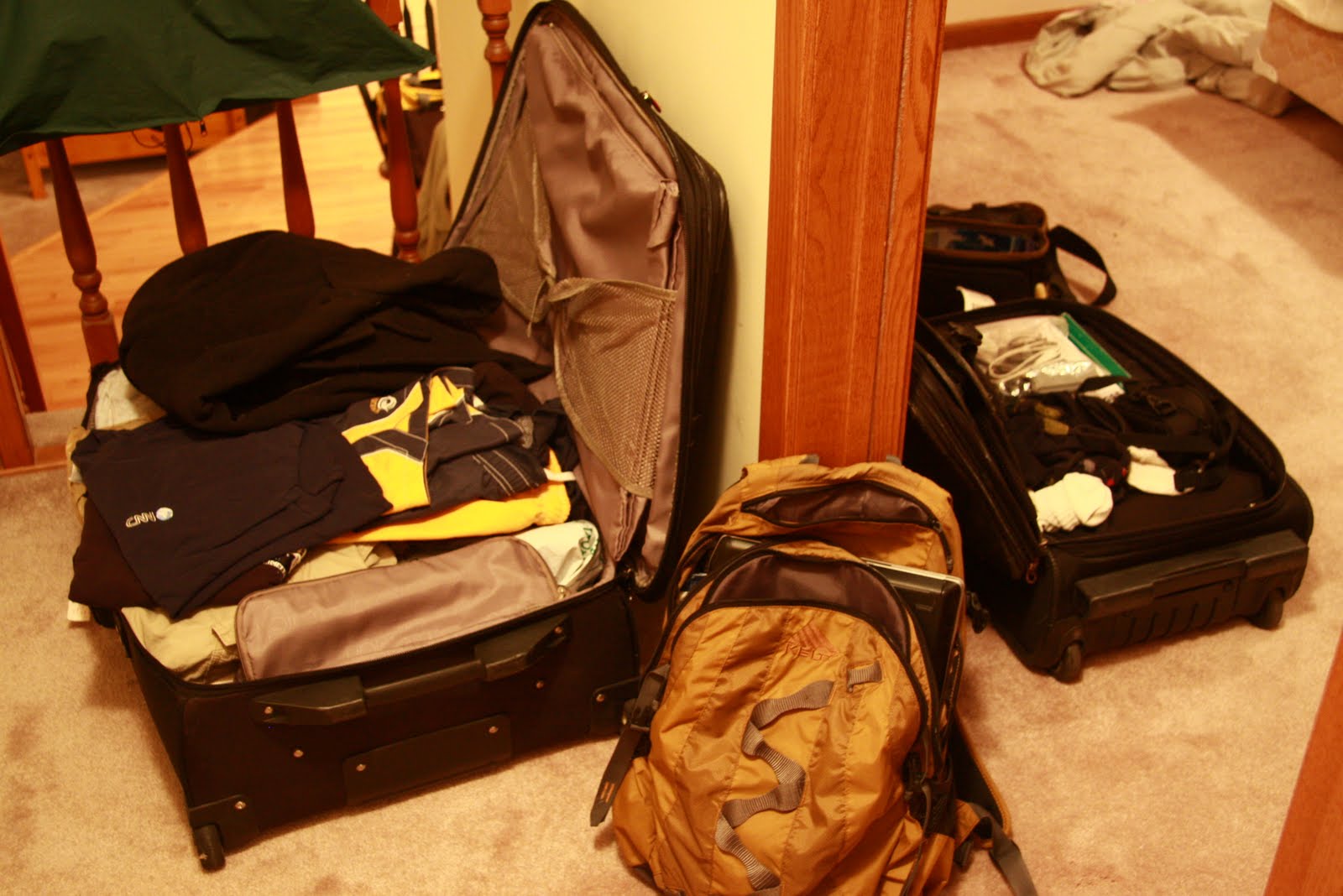
Will it fit? (based on the ads - "Will it blend?")
Resurrecting this blog after months in hibernation.... After almost 2 months in anticipating, I've finally packed for my NL trip... and very last minute too. Flight was scheduled for 11am on Sunday, and I just started packing around mid-morning on Saturday! And.. after viewing all my clothes, I started wondering, will it all fit? My goal was to get all my stuff (clothes, office equipment, etc) into 2 bags...
This problem is compounded by the fact that I have to pack for both summer/winter!
Sure enough, by 2am, I was totally packed into two bags! Although one is really pushing the limits. Better hope I don't see a busted bag and a trail of clothes and office equipment when I land in Amsterdam!
It was interesting to think about what to pack... should I pack spices there so I can make curries and biriyani dishes? What about the awesome Shun santoku knife that I love using? Would I ever be able to use a regular knife again? And what would I do without a rice cooker? In the end, only the curries made it (well, we'll see if TSA had other thoughts), but I'll see if I can go back to basics in the kitchen.
And also what about some music? I knew my cousin's classamte is living in NL with a piano, should I bring something to play? Or speakers for the computer? In the end, only the music made the cut (nice and thin), but it was interesting to see how we become so reliant on our "tools" at home, and these types of long trips force you to re-think what's truly important (especially when there's only so much you can carry). especially after just catching an old rerun of "Up In the Air" a few days before this trip...