Tuesday, September 24, 2013

Barcelona - Part 1 - Architecture


I recently had the opportunity to re-visit Barcelona, a city that I've had little background, other than a few hours in passing about 9 years ago. Back then, my only memory of Barcelona was the Sagrada Familia, the modern cathedral that was still being built 80 years later, and some paella.

Now, 9 years later, what a difference! First, the Sagrada Familia, the final masterpiece of Spanish architect Gaudi, while still under construction, is now actual working functional cathedral. I still remember hearing the sounds of drilling and hammering on the cathedral floor when I visited in 2004, but that sound has been replaced by hushed voices with a background of choral music.
Chapel under construction in 2004
Chapel in Sept 2013


There are some interesting architectural details from Gaudi - they are sometimes a bit surreal and odd, but quite clever. From my visit in 2004, I remember the tops of the cathedral towers were crowned with brightly colored pieces of fruit - like an apple, cherry, pineapples. Those same fruits were already showing their age, with their colors now muted by dust and age. In this trip, I continued to discover some interesting details. A colleague pointed out that the columns weren't the usual columns, but were designed to appear like trees, including some "corrugation" around the columns to look like bark, as well as the columns branching above to look like tree limbs. Even the branching patterns sometime appear random. Gaudi was able to combine the appearance of nature's randomness while maintaining architectural support into these columns.
Treetops and (a)symmetrical beauty


Sometimes, there are whimsical elements in the architecture, including these buildings near the front entrance of the cathedral. They share the Gaudi influence of "waviness" (I'm sure there's a more technical term for this), but at first glance, it appears like something out of the Smurfs!
Smurf village? or Gaudi masterpiece?


The cathedral is expected to be completed in 13 years, 2026, for the 100th year anniversary of Gaudi's death. Tragically, he was struck by a tram during the construction of the Sagrada Familia.

Barcelona is a living monument to Gaudi's archtectural style, as his buildings are scattered throughout the city. And despite the age of the buildings, nearly a 100 years old, the style remains quite modern to this writer's eyes.

Part 2... Spanish food and restaurant recommendations for future reference...

Sunday, May 12, 2013

Spring in Amsterdam, return of terraces and bikes

Spring in Amsterdam is always one of my favorite times of the year - usually marked by Queen's Day on April 30th. With the beginning of spring, this means the days are finally getting longer, people can stay and linger on the terraces, and the weather is warm enough for people to bike throughout the city.


As any visitor has experienced, bikes rule the roads in Amsterdam, and much of the Netherlands. The entire transit system is optimized for bike traffic: there are dedicated bike paths that run next to major roads, and if not, there are separately marked bike lanes on the streets. For the most part, bikes and cars share the road, although in my opinion, I think you'd be crazy to drive in Amsterdam given the volume of bike traffic. In fact, along some of the major intersections, because of the volume of bikes going with traffic, cars that are making a left or right turn often have to wait several cycles of the stoplight before being able to turn, due to all the bikes crossing. It's almost like the cars need a protected left/right arrow from the bikes!

Dutch bikes are built very differently from the styles normally seen in the US, and they're quite practical in design for weather and utility. For the wet/rainy weather, there's always a splash guard behind the front and back wheels, and there's also a covered chain so that you can bike into work in your suit without worrying about your pants getting stained by oil. For the brakes, instead of a disc brake along the wheelrim, there's an integrated brake hub that's connected to the axle. I assume this is to provide better braking performance when the wheels are wet, since the braking mechanism is sealed instead of exposed.

For utility, these bikes are designed for comfort and convenience. You'll first notice that the handlebars are curved, allowing the rider to sit straight upright, without "hunching". It increases drag, so definitely not good for sport racing, but it is comfortable for long bike rides of 20-30 minutes. Almost all bikes will have rear rack for carrying groceries, beer crates, or sometimes even crazier things like desks, computer monitors, even chest of drawers! With HS's help, we actually attached my heavy rollerbag onto my bike once, and successfully brought it from the train station to my house. Imagine, about 25 pounds of luggage strapped onto one side of my bike, and it was still balanceable!


For young mothers, there's also the baksfiets, which looks like something you'd expect on a farm, like a cross between a bike and a wheelbarrow. It's a bike with a huge "scoop" in the front (the bakje, or small container), where you can put the kids into the front. And in case of rain, there's a cover than can pull over their heads. If you're a young family living in the city, instead of a minivan, you get a bakfiets.


Besides the bikes, the nice spring weather makes for great walking-around weather. One of my favorite places to bike through is the huge Vondelpark, something like Central Park for Amsterdam. It's a huge open green space, surrounded by huge trees and amazing tall houses which are probably some of the most expensive addresses in Amsterdam. THe park is filled with huge paths for walking, biking, running, roller-blading. As the days get longer and the summer weather begins, the park gets filled with people enjoying a barbeque, playing cards, pick-up game of soccer, etc. I always enjoyed biking through the Vondelpark instead of taking the parallel streets when going between my old apartment and the center.. not only do you avoid traffic, but it's a great place to people watch, either from the park, or from the few cafes with terraces overlooking the park. Whether just enjoying a coffee and reading my Economist, or meeting up with friends for a drink, the Vondelpark is a great place just to relax and enjoy the outdoors.


The other advantage of the beginning of spring in Amsterdam is the long/late evenings.. this means that the sunsets start around 8pm and start to go later, and the city becomes very beautiful right around sunset, with the combination of the interior lights coming on just as dusk begins. Amsterdam houses (and maybe Europe in general) frequently have extremely large windows. I was never quite sure of the reason why, maybe because it allows as much light in as possible during the winter months where there's only 6-7 hours of sunlight? Or because the Dutch enjoy their openness, allowing everything inside to be seen from the outside? Or because the old canal houses have very narrow staircases, and thus having large windows are necessary to bring furniture in through the windows instead of the staircases? Either way, it makes for an amazing scene - seeing the warm glow from an interior room with ~15-20 foot ceilings just as sunset begins.


But of the best things about the spring and summer is the chance to enjoy a nice refreshing snack. In the Jordaan and throughout the city, there's a local chain of shops called "Yscupje", or "little ice cup", which sells excellent self-made ice creams and sorbets.
 The location in the Jordaan is particularly nice, as you can enjoy a cup of ice cream while sitting on the side of the canal surrounded by the canal houses, and watch the boats (and tourists) go by....

And for those looking for something less sweet, there's plenty of places to enjoy a drink - either going through the Heineken experience (not that I've ever done it, because it's too touristy), or finding a nice bier cafe (like Gollem on Overtoom), where you can enjoy a drink with a view of the street. And nothing better than meeting with friends and enjoying a drink from a local Amsterdam brewery "Brouwerij 't IJ". When are they going to start importing to the US?!

Monday, February 04, 2013

The future of Penang street hawkers?

On the way back from Georgetown, we happened across this friendly street hawker selling apong or apom, a Malaysian street snack that's similar to a filled crepe, crispy on the outside, soft on the inside, and in this case, filled with banana and sweet corn.


Run by a very friendly Mr. Guan (hence the name Apong Guan), he has been making apom for over 40 years, and apparently quite popular. While waiting for our order, there were already orders for around 50 pieces already in the queue, and several cars stopped by to place orders for 20 pieces! We ordered our minimum ten pieces, and watched Mr. Guan work while waiting for the order. While we waited, he was quite the entertainer, allowing us to "participate" in making our apom by having us try cooking a few pieces, and showed us an old photo, carefully wrapped in paper, of a much younger Mr. Guan, meeting one of the government ministers. He told us stories about various famous dignitaries, ordering apom from his non-descript cart, attached to a cycle, and parked in front of a schoolyard.


These street-side carts are quite common (and popular) in Penang, showing up at the same location, around the same time every day. It's quite a unique Penang tradition, as these street-side vendors are non-existent in Singapore, and nearly impossible in traffic-choked Kuala Lumpur.


After some time, I quickly noticed that most of these hawkers are quite old, especially in the case of Mr. Guan, who is probably in his 60's. These hawkers take their craft quite seriously, making each piece by hand, cooking with traditional methods, and avoiding most mechanization. In Mr. Guan's case, the only mechanization came from the gas tank heating his cooking plate, he still cut each banana by hand, and opened each can of corn by hand, mixed his apom batter by hand. It seems like a noble task, hand-making each of these snacks by traditional methods, shaded only by a tarp under the hot tropical heat.


I wonder what will happen to these vendors in the next 10 years. It's rare to find hawkers who are younger than 40, especially in the more famous stalls. Maybe this older generation don't want their children do be doing this type of difficult manual work. I do fear the loss of these old hawkers in the next 5 years... will these types of handmade snacks disappear? Will people lose the patience for waiting for these snacks? Will government regulate the street-side hawkers? Will this hawker generation retire without anybody following their footsteps?

In his case, and for all the other Penang street hawkers, I hope the tradition continues, and people realize what a unique place they have where these old food traditions are preserved.

Location: Apom Guan, opposite Sekolah Union, Jalan Burma, Georgetown, Penang, Malaysia.
Price: 10 pieces for RM4 (about $1.30)

Saturday, September 08, 2012

KL Food Review - Sri Paandi

As I'm preparing to leave NL, I'm finding myself trying to finish a number of old blog topics that I've wanted to write about. Hard to believe, but about 7 months ago, I was in SE Asia, and of course trying lots of new foods. I was recommended to go to Sri Paandi, an Indian banana leaf restaurant in Petaling Jaya. Apparently, it's very popular with people living in the area

From the outside, it looks like a typical Indian restaurant in Malaysia, and it gets better...


As you enter, they had some deliciously looking fried items, like vadas and such at the entrance...

It's pretty straightforward, you sit down, you get a banana leaf with rice, then these guys start coming around with various curries, sambar, and if you want, you can order additional fish/meat curries. In my case, I tried to get a bit of chicken, some veg curries, and pappadum on the side.


This guy (the "boss"), was very friendly and funny too, giving me this special hat so that I could be the "raja" of the restaurant


S and her family were either still full from our last meal, or weren't so interested in Indian dishes because it was too spicy, so they got some roti and naan instead, which were equally good!

We ordered for 4 people
  • 1x banana leaf rice
  • 1x goreng puyuh (?? fried quail?)
  • 2x naan
  • 1x mango lassi
  • 3x teh ais
 Total Cost: RM34 / USD10

Final verdict: tasty, hilarious experience wearing the special hat. Place is a little bit out of the way, I think you need a car or taxi to get there.

Restoran Sri Paandi
Petaling Jaya

Monday, August 27, 2012

Day in the Life - Antwerp

After over a year here, I've been taking the time to reflect on how things have really changed / progressed for me. I still remember arriving, very new, not knowing where anything was, still getting lost in the hospital... to today, where I know where everything is at, I feel comfortable getting anywhere, and have developed great friendships with the team here. It's something I can really feel proud about, growing from nothing to everything that I've built over the past year

To help me remember my time here, I thought I'd do a series about "day in the life", starting with my trips to Antwerp from Amsterdam. Although I lived in Amsterdam, I also had to cover Antwerp. Depending on my schedule, I'd rent a car for longer trips, or take the train for shorter trips.

1. By luck / chance, I happened to get an apartment near Amsterdam Lelylaan, which is only 5 minutes away by bike from my house. From here, there are frequent trains to Schiphol, and within 10 minutes, I'm at the airport. Such a strange feeling, biking to the train station, and arriving within 10 minutes to one of the largest international airports in Europe!

Amsterdam Lelylaan, with typical Dutch summer weather

2. Arrive in Schiphol, which has a fantastic train station connected with the airport, where I transfer onto the Thalys, the high-speed train to Antwerp. And it's seriously fast, I think like 180 km/h, so that's maybe 120 mph? If I'm hungry at Schiphol,  I always loved stopping by the Delifrance to get a sausijzenbroodje (sausage filled pastry.. totally unhealth) and a warme chocomel met slagroom (hot chocolate with cream...) Guess if I'm already going unhealthy, might as well do it all at once. =)
Schiphol plaza

3. One hour later, arrive in the beautiful Antwerpen Centraal station. There's usually wifi on the train, but it's so unreliable, especially with all the tunnels between Amsterdam and Antwerp. And besides, when I'm going to Antwerp, it generally means a sleep study, so I try to get as much rest as possible where-ever I can..

And - that reminds me of another story, the dangers of not getting enough sleep.. I once had to go to Antwerp right after a sleep study in Amsterdam, with only 2 hours of sleep, and I had all of my photography equipment with me to make a training video. Normally, when I traveled to Antwerp, I just brought a backpack for a daytrip, but this time, I had my suitcase.

I stepped off the train, almost right under the sign below, and started walking towards the escalator, when I realized... WHERE'S MY LUGGAGE! I had left it on the train!! And the Thalys stop isn't more than a few minutes. In huge panic, I ran back to the train, told the train attendant that my luggage was still onboard, she told me to quickly search since they had to leave soon. And in such a panic, I completely forgot which coach I was sitting in, and was running like a a crazy man going thru all the carriages, trying to find my luggage. Eventually I did find it, but that was a close call. Would have been terrible if I didn't get it on time, all my equipment, probably ending up in Paris (the final destination). Later on, this also happened to one of my colleagues, and the Thalys staff actually radio'd ahead to have the luggage brought offboard and locked up for retrieval.... but that was a close call. Note: make sure to always have some business card or contact info on your luggage!

Arrival in Antwerpen Centraal via Thalys
4. After arriving in Antwerp, I usually called my taxi-guy, Issah. It's so funny how we first met, I just chose a random taxi from the station, and got this native English-speaking Ghananian (ie, from Ghana) guy, and we just struck up a great relationship. He knows where to pick me up, always takes my calls, keeps me updated on Belgian and Ghana news, and a guy I could always trust. The 2nd time I was in Antwerp after meeting him, I had planned to call him ahead of time, but didn't have a chance... and when I went to the taxi rank, guess who I found first in line? Issah again!

5. UZA unfortunately is really far away from the center of Antwerp, so that's why I had to take a taxi. I initially tried going there with buses, but it just took too long. It's so far out of the city, they have chickens running around. (ok, it's only about 15 mins away, but it's funny to find chickens running around)

Chickens in front of UZA (University Hospital Antwerp)


6. Then, I head into my "home", the sleep lab. The staff there have been so nice to me, and so funny too. I've enjoyed hearing about one tech's travels to the US, how she loves travelling to the west, to the research co-ordinator, who sometimes "camps" overnight inside the hospital, since he has to be back in the morning, and it's easier to sleep in the hospital than to fight traffic going home. Amazingly, they have like 10 rooms, with 1-2 sleep techs the entire night. With 2 monitors per room, all mounted on the wall, it gets super-hot in that room! I think in the winter, we'd even open a window to keep the room cool enough!


And that's a typical night in Antwerp, another 6-7 hours at night in the sleep lab, then a very drowsy taxi/car ride back to my hotel, where I crash for the next 5-6 hours, then back to Amsterdam!

Sunday, August 19, 2012

Emergency dentist visit

A few weeks ago, I had my first interaction with the Dutch healthcare system. I woke up one day to a mild toothache, in a tooth that I've previously had problems and a previous root canal. Like all things, I decided to wait it out a bit longer, except it got painfully worse the second day. By that time, I thought, better call a dentist. But how? I had no idea how the Dutch dental system worked

Luckily, after talking with a few other Americans here, and Dutch colleagues, I found that the system supports both insured and non-insured (self-pay) patients, in my case, that would be me.

But - one might ask, how does it work for non-insured patients? Interestingly, the dentist I go to (and apparently other dentists here) publish all their prices! What an amazing concept - people in the US talk about wanting a more competitive healthcare market, but when have you ever seen prices listed, even for a dentist? (see pricelist from my NL dentist here)

I chose Tenden Tandaartsen based on a recommendation from an INSEAD classmate, and a nice location near the Leidseplein. A surprisingly pleasant experience. Very clean/modern looking waiting room, new digital x-ray and EMR equipment, English speaking assistants and dentists, and interestingly, a separate room for every patient. Totally unlike the US dentists, where everything is in the open, the only thing blocking your chair from the next is usually a bookcase, and you can hear the equipment or discussions with the patient next to you, etc. When I told my Dutch colleagues about this, they were completely shocked, apparently, European privacy rules would never allow a setup like that.


So - the total cost for an emergency visit, x-ray, and diagnosis? EUR90. That's probably cheaper than a self-pay cleaning visit in the US! Cleaning vists here: typically EUR30-50! The reason prices are lower are twofold: first, there's clear price competition, since prices are listed for patients, and the only government intervention is that there is a clear maximum price, but no subsidy. One might think that with a price cap, that would drive away dentists, but apparently, the maximum price is still high enough that there's enough dentists around town that can make a decent living. It's a "managed competition" environment. Furthermore, the choice between self-pay or insured gives people a choice based on their own needs. For regular cleaning and small things, it doesn't make sense to buy any dental insurance.

And the diagnosis - apparently, when my root canal was previously done, the dentist didn't do a correct job of removing all of the root, so there was some residual nerve that was being inflammed by a sinus infection. Very clear on the x-ray that there was 3mm root remaining. Grr - I hate it when people just don't do their job right. Luckily, watching/waiting worked more, and it just went away, with some help of ibuprofen.

In either case, a pleasant experience with the Dutch system, and a good model of where basic dental care could go if the market were truly competitive.

Saturday, July 21, 2012

Discovering Turkey Part 1

After reading in the EatingAsia blog about Turkey, the culture, history, and food, I've recently become fascinated with traveling around that region. Luckily, a few months ago, one of my Turkish INSEAD classmates invited me and another classmate to go exploring in Cappadocia, a place I had never heard about. I realized that I really didn't know much about the region. Growing up, most people study about Istanbul, maybe you hear abit about Ephesus, but after this trip, I learned that there's so much to see in Turkey, and that it's really felt like discovering a new place and country.


After getting the invitation from Erdem (my classmate), my first place to look was to study the wikipedia entry on Cappadocia. After seeing the pictures, I was totally hooked on going, and what better way than to go with a Turkish classmate that knows his way around.

Getting there was a bit complicated - I had to get to Ankara, in central Turkey, and then meet with my classmates, then drive another 2-3 hours into the Cappadocia region. I took the red-eye from Amsterdam on Turkish airlines to Istanbul.... and it's always a good sign when they call your name before boarding, because I got an free upgrade (!!) on the AMS-IST segment. That's the 2nd time it's happened to me on Turkish Airlines and particularly nice when you're taking the red-eye. It's more like US domestic coach, but they just block the middle seat and you have nicer meals. And I could at least get some sleep, since we left AMS around midnight, and the flight was 3.5 hours long.

"first" class seats on TK, with middle seat blocked

TK's meals, both in F and Y, are always tasty


Once arriving to IST at 3am, I had a 4-5 hour layover, since I wanted to take the same morning segment from IST-Ankara as my Turkish friends. Made my way into the TK lounge, and surprisingly, walked in without anybody checking my credentials. I somewhat knew that my Star Alliance silver status didn't include lounge entry on partners, but thought I'd try to sneak in with my F boarding pass, and nobody checked. That was nice - since I could actually sleep for a bit. But, I actually ran into a problem when exiting the lounge. Apparently, in IST, one can depart directly from the lounge to a bus that takes you to your gate. I didn't know this, so when I left the lounge and asked them how to get to my gate, they told me "there's a bus from here, just go back into the lounge". But, I couldn't get back into the lounge because I didn't have a Star Alliance Gold status, so I had to walk to the terminal. (no big loss, but a bit funny...)

I met my friends in IST in the morning, and then we ran into a bit of problems as TK was undergoing a strike, and our flight to Ankara was running a bit late, but not too bad, 30 mins or so. After arriving in Ankara, we immediately rented a car, and started our long drive to Cappadocia.

The landscape in that part of Turkey was really striking - a rocky, huge expanse, dry looking, but you'll see some farmers and goats/lamb herders. The highway is well-maintained, but fairly empty except for some big freight trucks and small passenger cars. However, there's still a bit of an "eastern" mentality as you get further out from the major areas, as my classmate was always stopping to ask for directions, and people would tell you directions to a nearest landmark, and you'd have to re-ask once arriving at that landmark.

A few interesting sights: an older Turkish lady, all covered up, but still working in the fields, gave me the impression that these were really hard working people. And, on the side of the road, you'll see these merchants, selling nuts and other dried fruit. Interesting fact - the hazelnut that you often see in chocolates, is actually originally Turkish .


And - my other "sign" of an eastern mentality, was how people thought of food. It really reminded me of traveling throughout Singapore / Malaysia, where everybody had an opinion of food, and could tell you where to go. After buying a few dried fruits and nuts from this roadside vendor, my friend asked where we should get lunch, and got a recommendation down the road. When we arrived, it was just a small roadside restaurant, with indoor and outdoor seating, and the food was really great. Turkish "quick-service" restaurants typically have a few set dishes pre-prepared: some type of kofte (elongated meatball), vegetables (usually peppers, eggplant, zuchhini, etc), rice pilaf, and of course bread.
Turkish roadside restaurant

That's where I was first introduced to izmir kofte, incredibly tasty beef/lamb kofte in a tomato sauce. And this was generally true of most of the restaurants that we went to throughout Turkey - all of them had great food, everything seemed freshly prepared, there's a lot of care to have fresh vegetables along side the dish. Also, I didn't yet notice any mass commercialization, even in the large cities. And of course, meals were very affordable, a nice dinner might be EUR15 or so, but typical good dinner might be EUR10.

Izmir Kofte

And after a few hours more driving, we finally arrived in Cappadocia. It was an incredible view, an old town, completely cut out of rock. You would see this huge plain, with these "stone hills", and evidence that people have carved out cave homes from them, and have lived there for centuries. It was almost like seeing something out of Smurfs! We had booked a fantastic hotel, Hotel Ahbap Konagi, run by a French / Turkish couple. They've renovated a number of rooms that had a fantastic view of the hills / caves on their outdoor terrace.

View of the Cappadocia area


On our first night there, we sat outside on the terrace, talking about old times in the dark, with a view of the hills, and sounds of Turkish music from the nearby houses. It was one of those "moments" when you realize you're in a new, strange place, and there's a sense of wonder, that you can't believe you're actually there. And I was, completely amazed, and so glad that my Turkish friend had invited me to this place, someplace I'd never heard of before!
View from our hotel at night


Saturday, May 26, 2012

Queen's Day and the beginning of summer

Wow, it's been so busy here, I can't believe i haven't posted since February. It's finally summer, and it all started with Queen's Day, on April 30th. We were incredibly lucky for the weather - it was clear and warm! (and strangely, the Sunday before, and the Tuesday after worth both miserable days...)

A little history about Queen's Day: it's probably the biggest public holiday in the Netherlands, celebrating the birthday of the last Queen (since the current's Queen's birthday is sometime in winter!). Everybody wears orange clothes (the official name of the Dutch royalty is the House of Oranje (orange), which is related to William of Orange in the UK, for those who remember their European history, who became King William (with Queen Mary) in England)


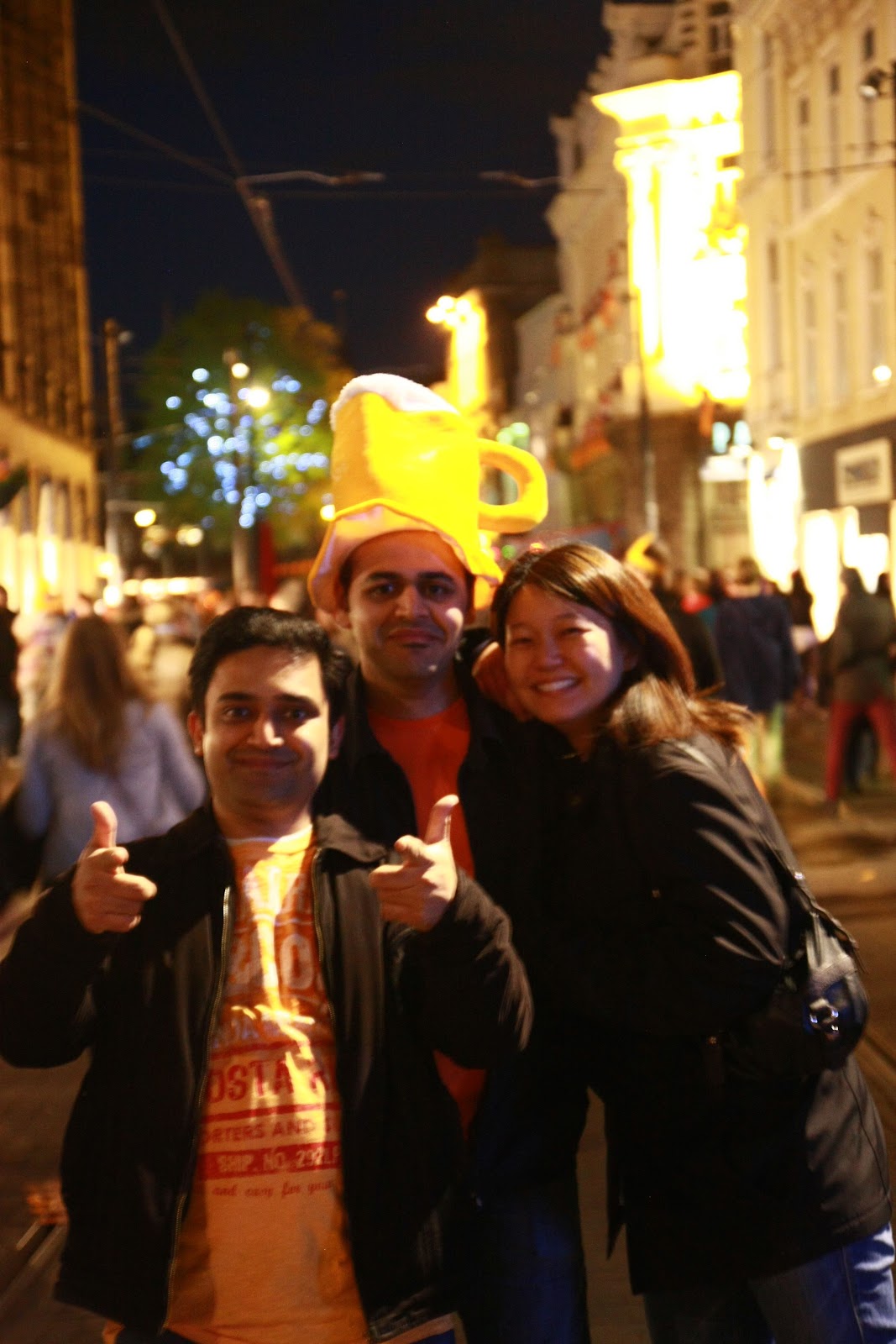
First, celebrations start with Queen's night, where lots of bands are playing, and people are already out partying, having fun, dressed in funny hats and anything orange, and buildings are decorated with Dutch flags and red/white/blue stripes. 


Queen's day is a huge celebration, especially in Amsterdam. Everybody is outside wearing orange! Who knew that clothing companies would even make that many clothes in that color! (maybe only for people in NL?)

Also, one of the unique things about Queen's Day: is that she grants free permission for anyone to sell things openly. It's like a fun garage sale, people are selling their old clothes, records, home-cooked food, etc. People will even mark/reserve their spots on the pavements even days before Queen's Day

And, although this year the bands were mainly moved outside of the city center, there's still lots of music, especially in the floating barges/boats that are travelling around the canals, with their own DJ's, and pumping out loud dance music...(check out the YouTube video...)
 

Luckily, I came equipped with my Dutch/German week orange INSEAD polo-shirt, and Douwe-Egberts (local Dutch coffee company) was giving out these fantastic orange fedoras to complete my Queen's Day outfit.

The Dutch were really festive, and it was something comparable to Carnival in Den Bosch. It's an interesting comparison, because I think people in North Holland particularly like their regels (rules), and it's funny to see for 1 day, all the regels are disregarded... and very quickly, by the end of Queen's Day, the streets are being cleaned, and everything is back in order by the following day! So rRemarkably efficient, as if the rules can only be "broken" for only one day, but then everything needs to be back in order!

It was a great and hilarious experience, thanks to my INSEAD and hospital friends for making the day special! Definitely worth coming back to NL just for the experience...